
Smithfield Warrant Checks
Smithfield Police is the local starting point for a question about a department incident or report. A court warrant is different: Smithfield’s justice court was dissolved effective April 1, 2021. Preserve the old citation or case number and ask Utah Courts or the First District which office now holds the docket. The statewide search may help identify a court, but a direct clerk confirmation is needed for current status.
- Decide whether the question concerns a Smithfield Police incident record or a court docket.
- For a police record, use the department’s published contact; do not treat it as a warrant lookup.
- For a historical court case, search the official Utah statewide warrant system and note the court and case number.
- Ask the Utah Courts directory or First District clerk where a former Smithfield case is now assigned.
- Confirm any warrant, appearance, or bond instruction with that court before acting.
Police Service Remains Local After Court Closure
The court’s dissolution did not dissolve the police department. Smithfield Police publishes its address as 55 E 100 S, Smithfield, UT 84335, with the public number (435) 563-8501 and police@smithfieldutah.gov. Central Dispatch at (435) 753-7555 is listed for after-hours contact. These details direct an agency question; they do not identify who now controls a former justice-court case.
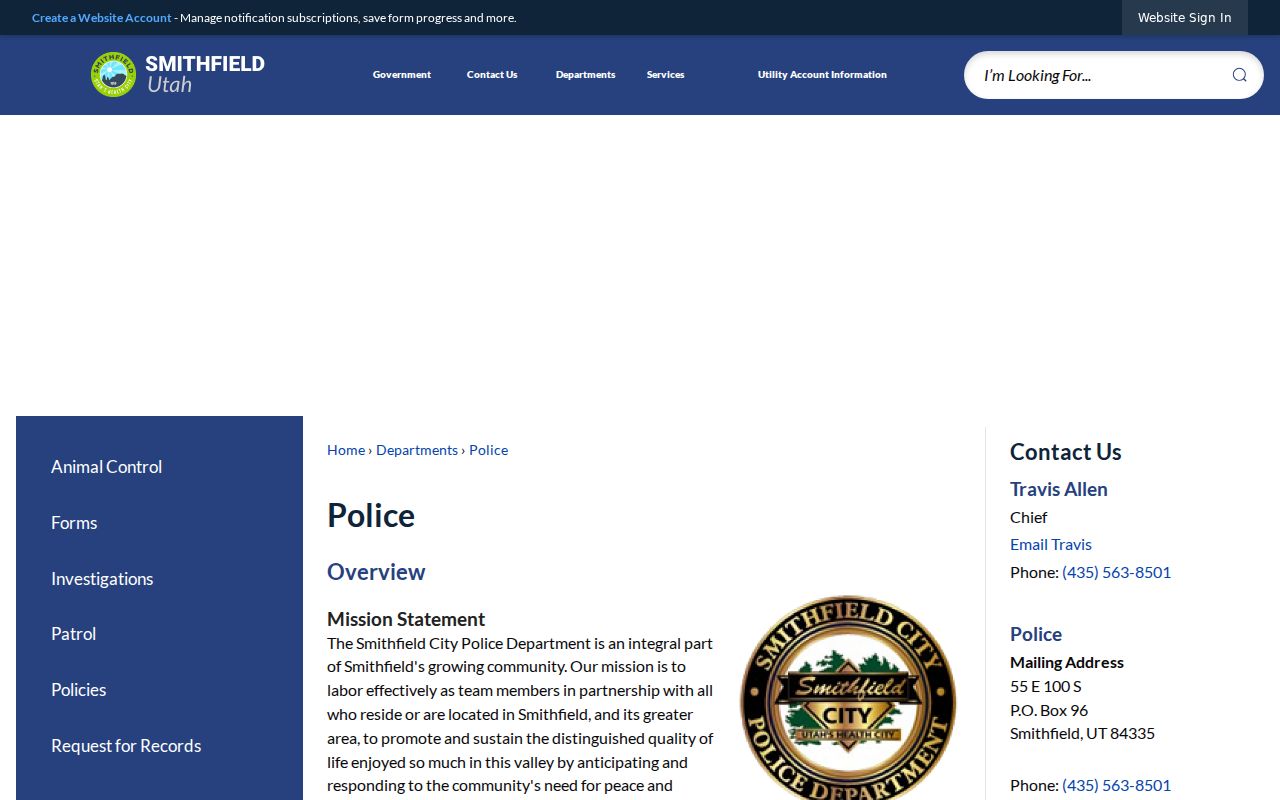
Use that contact for police-held records, then follow the court name on a former citation separately.
Policing and Courts in Smithfield
Smithfield’s official council and financial materials identify the city justice court as closed effective April 1, 2021. The city’s current police page is still useful for police-held records, but no current city-court warrant portal was identified. An old payment link or retained website menu should not be taken as proof that the former court is operating.
For a court matter, take the old docket number to Utah Courts and request the present assignment. The record set may be historical, transferred, or otherwise handled under the current court directory. The available research does not establish one replacement portal that resolves every older Smithfield case.
Why a Police Report and Warrant Are Different Records
A Smithfield Police report documents an agency event, subject to public-record restrictions. A warrant is a judicial order entered in a court case. A police records request can produce an incident record but cannot recall a warrant, set a hearing, or confirm whether a judge changed bond terms. Identify the record first so the request reaches the office with authority to answer.
Warrants in Smithfield: The Main Types
A historical Smithfield case may involve a traffic citation, a missed court appearance, or another court order. The former city court’s closure does not decide the status of an individual order. For a new matter, the court named on the notice controls the docket; the location of the incident alone does not tell you which court to contact.
| Warrant Type | How It Arises | Who Issues It |
|---|---|---|
| Traffic matter | Citation filed in the court identified by the record | Current issuing court |
| Failure to appear | Missed event on a court’s calendar | Judge assigned to the docket |
| Arrest warrant | Judicial order connected to a filed case | Issuing magistrate or court |
| Agency record | Police report or incident entry, not itself a warrant | Smithfield Police records custodian |
Check Dates on Old Smithfield Court Links
City pages and search results can preserve links long after a court’s status changes. When a link does not show a publication date or current clerk contact, treat it as historical context only. Compare it with the Judicial Council or Utah Courts directory, then ask the current court to locate the docket. A working payment button does not show that the old court still has authority over the case.
Smithfield Warrant Records: What They Show
A statewide result or public court summary may show a court name, case number, charge, and an order status. Older cases may use a former court label. Compare identifiers before deciding that a match is yours, and ask the current clerk whether any action remains. A police incident record uses separate fields and should not be interpreted as court status.
| Warrant / Case Number | Include any legacy court notation when asking the current clerk to find the file. |
|---|---|
| Subject Name | Names can overlap; use private case identifiers to confirm a match. |
| Charge / Offense | The allegation or citation linked to the docket, not a verdict. |
| Issuing Court | A former Smithfield court label may require current routing through Utah Courts. |
| Bond / Fine Amount | Ask the court with the current docket whether any amount or condition remains due. |
| Status | Confirm the newest court action; old web links can outlast the court. |
Police Records Requests Have Their Own Process
For a Smithfield Police incident file, make a records request to the agency that holds it and be precise about the incident date or report number. County Sheriff’s Records, which is separate from city police, describes GRAMA requests, a response window of up to ten working days, and limits on active reports. Those agency-record rules do not determine whether a court warrant is open.
Smithfield Warrants and Cache County
For a county warrant verification or service question, Cache County Sheriff lists (435) 755-1000; broader public lookup is through Utah’s statewide system. These county routes do not establish which court controls an older Smithfield docket. Start with the former court name and number, then use the current court directory. The Cache County records home and county warrant-check page explain those wider paths.
Warrant flow: Smithfield Police for agency records › Utah Courts for current docket routing › Cache County Sheriff for county verification or service.
A historical court case and a current police incident report are separate files with separate custodians.
No Current Smithfield Warrant Roster Was Found
The reviewed city police and civic pages did not provide a public Smithfield warrant roster or a new city court portal. Do not turn the police contact page into a people-search page or rely on old court menu links as proof of current authority. A court clerk can confirm the docket, while police can explain access to agency records.
City notices help establish present agency contacts, not the status of an older case.
Smithfield’s Population Does Not Predict Warrant Activity
The 2020 Census population for Smithfield was 13,571. That makes the city second in the top-five profile order used here, but it says nothing about citations, warrants, or police calls. The date on the count matters too: it is a 2020 figure, not a current estimate or a measure of court workload.
Accessing Smithfield Warrant Records
Utah court-access rules govern public court files; sealed, juvenile, expunged, and other nonpublic records may not appear in a public search. A police incident request follows GRAMA and goes to the police agency that maintains it. Neither a public court summary nor a police report should be republished as a list of private individuals.
Key Rules:
GRAMA, Utah Code §63G-2-301 - provides access to qualifying government records subject to statutory limits.
Utah Rule 4-202 - sets public-access categories and exclusions for court records.
Utah Code §78A-6-209 - restricts juvenile case information except where law permits disclosure.